

28th January (two days from now) marks the 174th death anniversary of Bajirao II, the last Peshwa (Prime Minister) of the Maratha Empire. He sought help from the East India Company against his own people, restored himself as the nominal head of the Empire with the British help, and in the end, completely surrendered to them after an unsuccessful attempt to free himself from their authority and lived the rest of his life in exile in faraway Bithoor near Kanpur.
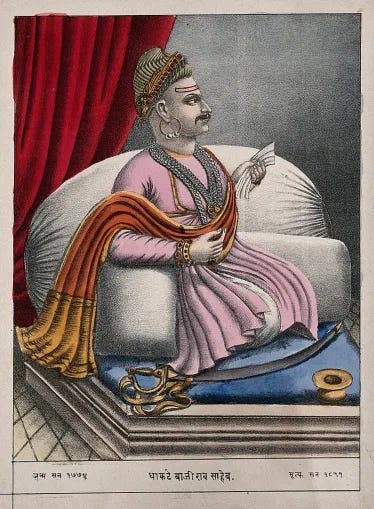
Here are some notes I took on an article I read some time ago.
The last Peshwa was born on 10th January 1775 and died on 28th January 1851.
He presided over an empire in decline. The Treaty of Bassain (Vasai) he signed with the EICo in 1802 is considered the beginning of the end of the Marahtta Empire. Under the treaty, he was restored as the nominal head of the empire in 1803 (without the title of Peshwa) with his powers significantly curtailed. He had to operate under the influence of the EICo.
The Third Anglo-Maratha War (1817–1818), for all practical purposes, marked the end of the Maratha Empire in India. The seeds of this war were sown on the arrival in Pune of Gangadhar Shastri, a “company-endorsed” envoy of the Gaikwad of Baroda, to negotiate a long disputed revenue settlement.
Gangadhar Shastri was murdered in Pandharpur (or Pune?) in July 1814. The EICo took this as a ruse to further curtail the power of Baji Rao II, extracting large amounts of land and imposing several other restrictions, ensuing the battles of the Third Anglo-Maratha War, which sealed the Peshwa's fate. He surrendered to John Malcolm, the company’s officer in charge of Central India at Mhow, in May 1818.
The terms of his surrender required him to give up all his titles and claims of sovereignty and leave for “Hindustan” without a day’s delay. The surrender also included an agreement for an annual pension of at least ₹8 lakh for the maintenance of the ex-Peshwa and his followers.
After some deliberations, Baji Rao II agreed, arriving at Malcolm’s camp at Khairi on 2nd June 1818. Khairi lies in the Nimar region, where his illustrious grandfather and namesake, Baji Rao I, breathed his last at Raverkhedi in 1740.
A military escort was arranged to take the ex-Peshwa to a yet undecided destination up north. Lt. John Low, Malcolm’s assistant, was assigned to lead the escort at Baji Rao’s request. The party proceeded towards the north via Rajputana, skipping the Bundelkhand route due to political unrest and monsoon.
The final destination of Peshwa’s exile was still not decided. Varanasi, initially a choice of Peshwa’s advisors, was rejected by the Governor General. Mathura was also rejected as it was on the frontier of the company’s territories.
Baji Rao’s advisors were not too keen on some other cities that were considered. Gorakhpur had no famous temple of distinction, Gaya was considered to be too expensive, and Munger was too deep in the company’s territory. Finally, Bithoor was finalised as the destination. It was conveniently located near Kanpur, where the British had a large cantonment and an existing community of some Marathi-speaking people.
Baji Rao built a 35-acre palace in Bithoor. A modest community gathered around him, from which he appointed officers with titles similar to those of his former administration. Part of the pension was spent on building public infrastructure. Stones from Mirzapur and wood from Patna were purchased for the construction of a temple, a ghat, and a house for priests at Benares. Additional stones were procured from Mirzapur for a temple at Bithoor.
As of December 1837, 7,132 people lived on the estate, which included “500 sowers and 450 sepahis".
Ramchandra Pant, formerly a Subedar in Peshwa’s service in Carnatic, acted as his Dewan and held that position until Baji Rao’s death. Subedar Pant had commanded an army of 5,000 in his earlier days and had fought against the British; he had seen wounds in action, but in the changed circumstances, he was considered a trusted ally by British commissioners. The ex-Peshwa extended loans amounting to several lakhs to the British, secured partly with some help from Ramchandra Pant.
Baji Rao’s younger brother Chimaji Appa II settled in Varanasi, where one Moropant Tambe from a village named Venu near Matheran worked with him. After Chimaji's death, Moropant Tambe moved to Bithoor with his daughter, Manikarnika.
One Pandurang Yewalekar managed Baji Rao’s religious and household affairs. Pandurang had been employed by the Peshwa from Pune and followed him to Bithoor with his family. One little child in this family was Ramchandra Pandurang, later known as Tatya Tope.
Baji Rao did not have a male heir, a fact that proved very convenient and consequential under the doctrine of lapse. He got married six times, but none of the marriages produced a male heir. In later years, he adopted three sons and a daughter, the eldest of whom, Dhondopant aka Nanasaheb II, became his heir apparent.
On 26th January 1851, Baji Rao fell ill and was attended by British doctors, who confirmed the impending news to the commissioner. He died 2 days later, at the age of seventy-seven.